
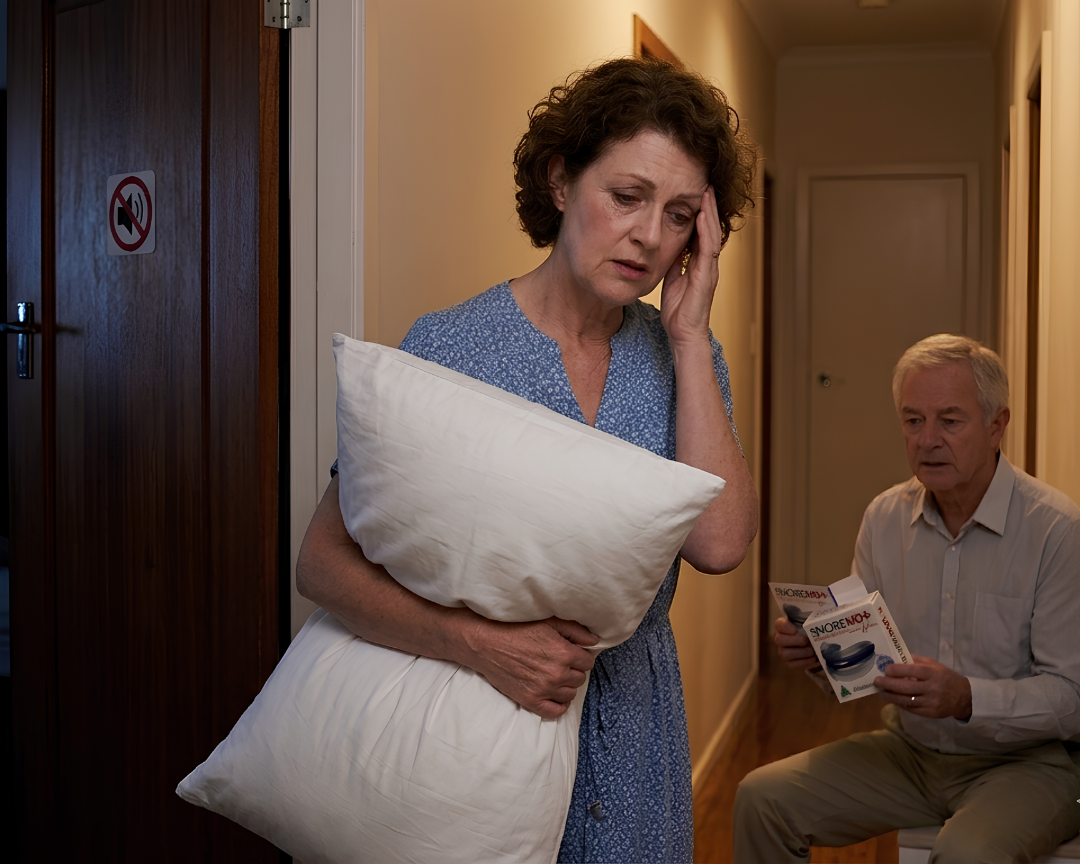
It usually doesn’t begin with a big argument.
It starts with something small. A nudge in the dark. A frustrated sigh at 2:17am. Maybe a pillow thrown over the head, or a long walk to the spare room that becomes less “temporary” and more routine over time.
Across Australia, this story is becoming increasingly common. Not dramatic enough for courtrooms at first, but powerful enough to quietly reshape relationships.
Because snoring is not listed as a legal reason for divorce under Australia’s no-fault divorce system, many relationship experts and sleep health researchers agree on something important: snoring and divorce are often connected indirectly through sleep deprivation, emotional strain, and the gradual erosion of intimacy.
The question couples are really asking: can snoring cause divorce?
On paper, no.
In real life, many Australians would answer differently.
There is no official statistic that says “X% of divorces are caused by snoring” because it rarely appears as a single legal reason. But the pattern is consistent in sleep and relationship research.
- Around 26% of Australians say their partner’s sleep issues keep them awake
- Roughly 66% of adults report at least one sleep problem
- About 10% of Australians in sleep surveys say snoring directly contributed to relationship breakdown
- And a 2023 report found around 38% of couples have tried sleeping in separate rooms, with snoring and loud breathing cited as the number one reason
What begins as a nightly disturbance often becomes something deeper: resentment, disconnection, and emotional fatigue.
This is where the idea of a “sleep divorce” enters the picture.
The rise of the “sleep divorce” in Australia
A growing number of Australian couples are not formally separating, but they are sleeping apart.
This isn’t framed as relationship failure at first. It is framed as survival.
Separate rooms. Separate blankets. Separate routines.
But over time, many couples notice something unsettling: the bed wasn’t just a place to sleep. It was where connection quietly happened.
Without it, lack of intimacy in marriage begins to show up in subtle but meaningful ways.
- Fewer spontaneous conversations before sleep
- Less morning affection
- Reduced physical closeness
- A growing sense of emotional distance
Research from the Sleep Health Foundation suggests that 1 in 5 Australian couples report snoring negatively affects their love life, and around 40% of partners with sleep issues say it puts significant strain on the relationship
It is rarely just about sound. It is about what the sound prevents.
How snoring slowly changes intimacy in real life
Ask couples who have lived with chronic snoring, and the story is surprisingly consistent.
First, there is patience. Then adaptation. Then quiet frustration.
The non-snoring partner often begins sleeping lightly, always half-alert. Waiting for the noise. This state of hyper-awareness disrupts emotional regulation, meaning small disagreements during the day feel bigger than they should.
Over time, intimacy changes in three subtle ways:
The first is emotional distance. Sleep deprivation affects empathy, making partners more reactive and less patient. Misunderstandings become more frequent.
The second is physical separation. What starts as “just a bad night” turns into permanent room splitting.
The third is identity shift. Couples begin describing themselves less as partners and more as “roommates with history.”
This is where terms like lack of intimacy in a relationship or breaking up because of lack of intimacy start appearing in real conversations, not just search queries like snoring divorce, snoring causes divorce, or does snoring cause divorce.
The emotional toll most couples don’t talk about
Snoring affects both people in the relationship, just in different ways.
For the non-snoring partner, there is exhaustion, frustration, and a growing sense of invisibility. Sleep loss impacts mood and judgment in ways that can feel similar to chronic stress. Arguments become easier. Patience becomes harder.
For the snoring partner, there is often something else: shame.
Many don’t hear themselves snoring. So being moved to another room, or being nudged awake repeatedly, can feel confusing or even rejected. Over time, defensiveness can build, especially if they feel the problem is being blamed on them rather than treated as a shared health issue.
This is where relationships reach what some therapists call the “breaking point phase”: not because of snoring alone, but because of how long it goes unaddressed.
How long until “I can’t take the snoring anymore”?
There is no fixed timeline, but patterns do appear in Australian relationship support settings.
In many cases, couples move through three stages:
Early years involve tolerance. Earplugs, sleeping on the couch occasionally, or laughing it off.
Then comes resentment. Often within a few years, separate sleeping begins. This is the beginning of the “sleep divorce” stage.
Later, if nothing changes, frustration turns into emotional distance. At this point, the issue is no longer just snoring. It becomes about feeling unheard or unsupported.
The turning point is rarely the noise itself. It is the moment one partner stops believing anything will change.
The quiet intervention: when couples start looking for solutions
Interestingly, many relationships improve not when snoring disappears overnight, but when effort begins.
In Australia, couples increasingly seek practical solutions rather than accepting separation as the default.
This includes GP sleep assessments, sleep studies for conditions like obstructive sleep apnoea, and lifestyle adjustments.
But for many, the most immediate change comes from simple, accessible tools.
Over-the-counter options like nasal dilators, positional aids, or oral devices are often the first step.
Among these, mouthpieces for snoring solutions, particularly mandibular advancement devices, are widely used for home management.
One example is SnoreMD, an adjustable anti-snoring mouthpiece designed to support airway alignment during sleep. It is part of a broader category of anti-snoring mouthpiece options often searched as best stop snoring mouthpiece, best rated anti snoring mouthpiece, or best snore mouthpiece.
While no device is a universal fix, what matters most in relationship terms is not perfection. It is a reduction. Enough quiet to restore shared sleep.
Why solutions like SnoreMD matter for relationships
When snoring is treated as a shared problem rather than a personal fault, something shifts.
Couples often report improvements not just in sleep, but in mood and connection.
In practical terms, consistent use of a device like SnoreMD can:
- Reduce nighttime disturbances that lead to separate sleeping
- Improve sleep quality for both partners
- Lower resentment linked to chronic sleep deprivation
- Restore shared bedtime routines and intimacy
Some sleep clinicians in Australia observe that when couples return to the same bedroom, emotional closeness often follows naturally. The “sleep divorce” begins to reverse.
The bottom line for Australian couples
So, is there a direct correlation between snoring and divorce in Australia?
Not in legal statistics.
But in lived experience, in sleep research, and in counselling rooms, the link is difficult to ignore.
Snoring does not usually end a marriage on its own. But unmanaged, it can slowly weaken the emotional foundations that hold a relationship together.
And often, the real turning point is not silence.
It is an effort.
Because when a couple decides to address snoring together, whether through lifestyle changes, medical support, or adjustable snoring mouthpieces like SnoreMD, they are not just fixing a sleep problem.
They are rebuilding something far more fragile and far more important.
Their ability to rest in the same room, and wake up still feeling like a team.