
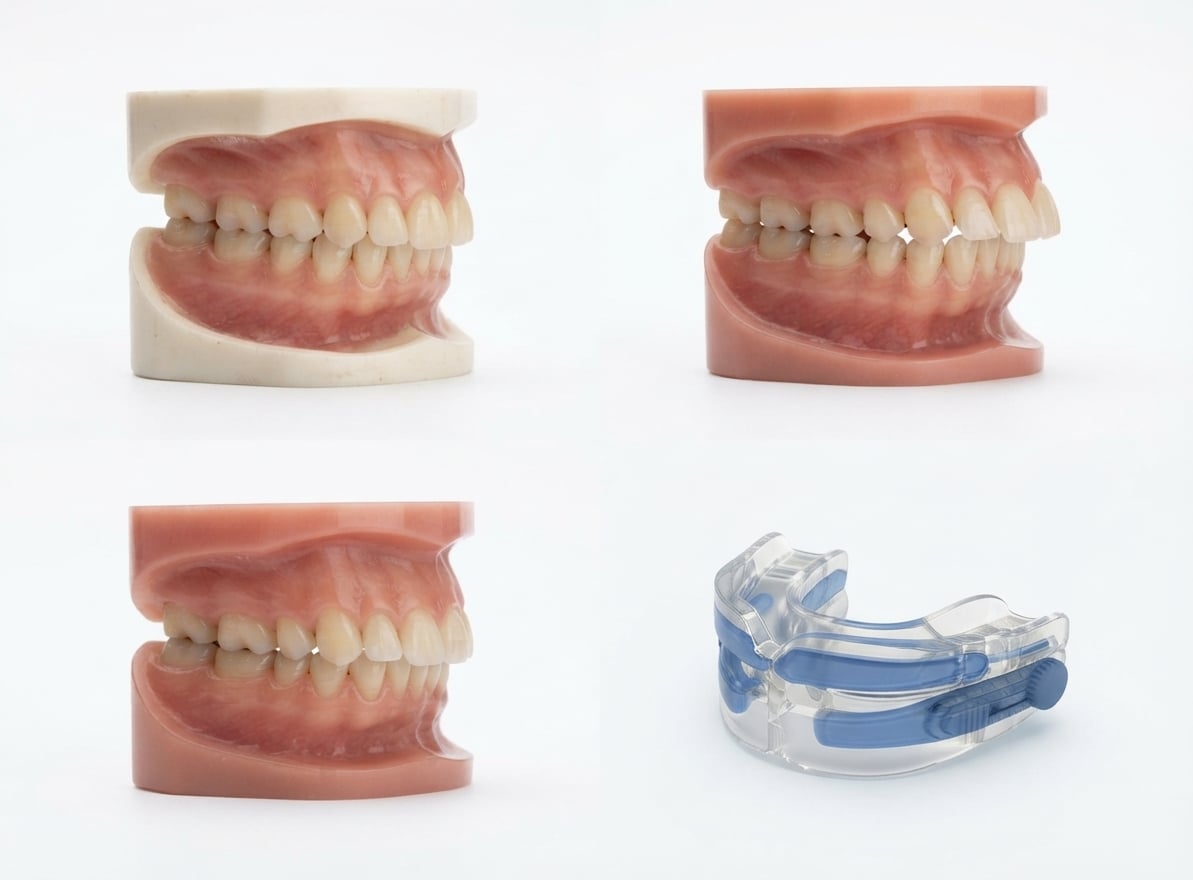
If you have an overbite, underbite, excessive overjet or another type of bite misalignment, you may have wondered whether a boil-and-bite anti-snoring mouthguard such as SnoreMD is suitable for you.
It is a reasonable question. After all, SnoreMD works by gently positioning the lower jaw forward while you sleep. So what happens if your jaw and teeth do not naturally line up in a typical bite?
The short answer is: some people with mild bite differences may be able to use SnoreMD, but a significant or complex occlusal problem should be assessed by a dental professional before using a mandibular advancement device.
SnoreMD is designed to provide relief from snoring. It is not designed to correct an overbite, underbite, excessive overjet or other orthodontic or occlusal problem, and it should not be used as a substitute for orthodontic or dental treatment.
SnoreMD’s own guidance states that people with minor overbites or underbites may often be able to use the device, while people with more pronounced misalignment should consult a dentist to assess suitability and fit.
What is occlusion and why does it matter for snoring?
Occlusion simply refers to the way your upper and lower teeth come together when you close your mouth.
A healthy, stable bite is important when using an oral appliance because the device sits around the teeth and applies forces to reposition the lower jaw during sleep. Dental sleep medicine assessments therefore consider factors such as your bite, teeth, gums, jaw movement, existing dental work and the health of the temporomandibular joints.
This does not mean that teeth occlusion directly causes snoring in every person.
Snoring has many possible causes, including the anatomy of the nose and throat, relaxation of the upper-airway tissues during sleep, sleeping position and other individual factors. A particular jaw or bite relationship may contribute to airway narrowing in some people, but it is not accurate to assume that an overbite or underbite is automatically the cause of someone’s snoring.
That distinction matters because treating the bite and reducing snoring are two different goals.
Does an overbite cause snoring?
An overbite may be associated with snoring in some people, but an overbite does not automatically mean that you will snore.
An overbite describes vertical overlap of the upper front teeth over the lower front teeth. It is different from overjet, which describes how far the upper front teeth extend horizontally beyond the lower teeth.
Some people with a more retruded lower jaw may have a bite relationship that also affects the position of the tongue and the available space in the upper airway. During sleep, when the muscles supporting the airway relax, this anatomy may contribute to airway narrowing and snoring.
This is one reason mandibular advancement devices can help some people with snoring. Rather than correcting the underlying bite permanently, a MAD temporarily positions the lower jaw forward during sleep.
So, if you are searching for “does an overbite cause snoring?” or “can an overbite cause snoring?”, the more accurate answer is:
An overbite can be associated with anatomical factors that contribute to snoring, but an overbite alone does not prove that it is causing your snoring.
What about excessive overjet and snoring?
Excessive overjet and snoring can be related, particularly when the increased horizontal distance reflects a retruded lower jaw.
However, overjet and overbite should not be treated as interchangeable terms.
An excessive overjet means the upper front teeth sit substantially forward of the lower front teeth. In some people, this reflects the position of the lower jaw rather than simply the angle of the teeth.
Because a mandibular advancement device moves the lower jaw forward, this can make an oral appliance particularly relevant to people whose snoring is associated with a retruded mandibular position.
But that does not mean SnoreMD corrects an excessive overjet. It does not. The forward positioning is temporary and intended to help maintain the airway while sleeping.
If your overjet is pronounced, your dentist or orthodontist can determine whether the dental relationship allows an oral appliance to be used safely and comfortably.
Can people with an underbite use SnoreMD?
This is where things can become confusing.
An underbite, often associated with a Class III bite relationship, means the lower front teeth sit in front of the upper front teeth when the teeth are closed.
Because SnoreMD is a mandibular advancement device, you may assume that anyone with an underbite cannot use it. That is not necessarily the case.
SnoreMD states that people with minor underbites may often be able to use the device, while more pronounced misalignment should be assessed by a dentist.
The important question is therefore not simply:
“Do I have an underbite?”
It is:
“Can my teeth and jaw comfortably and securely accommodate the amount of mandibular advancement required?”
A dental professional can assess this more accurately than looking at the appearance of your bite alone.
And remember, having an underbite does not mean your snoring is caused by your bite. Snoring can still result from nasal obstruction, throat anatomy, sleeping position and other factors.
Can you use SnoreMD with a mild overbite?
Possibly, yes.
SnoreMD specifically notes that people with minor overbites may often be able to use the device.
This makes sense mechanically because SnoreMD is designed to advance the lower jaw. A mild overbite does not automatically prevent the device from fitting or functioning.
However, a mild overbite is very different from a severe overbite or deep bite.
If you have a pronounced overbite, significant overjet, difficulty moving your jaw forward or discomfort when your jaw is advanced, it is better to have your bite assessed before relying on an over-the-counter mandibular advancement device.
When should you speak to an orthodontist or dentist first?
If you already know that you have a significant bite or dental problem, professional advice is particularly important.
You should speak with a dentist, orthodontist or appropriately qualified dental sleep professional before using SnoreMD if you have:
- A pronounced overbite or underbite
- A significant excessive overjet
- A crossbite or open bite
- Difficulty moving your lower jaw forward
- Jaw pain, locking or significant clicking
- Loose teeth or significant gum disease
- Extensive dental work that may affect the fit
- Dental implants
- Dentures
- Current orthodontic treatment
- Recent orthodontic treatment
SnoreMD’s published contraindications include a history of temporomandibular disorder, recent dental implants or orthodontic work, current orthodontic treatment, dentures, loose teeth, abscesses and severe gum disease.
That is why a boil-and-bite mouth guard for snoring is not automatically suitable for everyone simply because it can be moulded to their teeth.
What if I have braces or recently had orthodontic treatment?
This is an important distinction.
A boil-and-bite anti-snoring mouthpiece is not the same as an orthodontic appliance. SnoreMD’s instructions state that it should not be used by people undergoing orthodontic treatment, and it lists orthodontic work within the previous year among its contraindications.
If you have braces, recently completed orthodontic treatment or are waiting for your teeth to stabilise following orthodontic treatment, ask your orthodontist before using an oral appliance.
Your teeth and bite may still be changing, so a device that holds the upper and lower arches together overnight needs to be considered carefully.
Do occlusal guards help with snoring?
This is another common source of confusion.
An occlusal guard, occlusal splint or conventional bite guard is generally designed for a different purpose, such as protecting teeth from grinding or managing certain dental or jaw-related problems.
A mandibular advancement device, on the other hand, is specifically designed to position the lower jaw forward during sleep.
So if someone searches for:
- “do occlusal guards help with snoring?”
- “occlusal guard for snoring”
- “occlusal splint snoring”
- “bite guard for snoring”
- “occlusal splint stopped snoring”
it is important not to assume that any appliance worn over the teeth is an anti-snoring device.
Some people may notice that their snoring changes while wearing a particular dental appliance, but that does not mean a conventional occlusal guard is equivalent to a mandibular advancement device.
For snoring, the mechanism matters.
How is a SnoreMD mouthpiece different from a regular bite guard?
SnoreMD is a mandibular advancement device (MAD). Its purpose is to hold the lower jaw forward during sleep.
It is moulded to the user’s teeth and can then be adjusted in 1 mm increments to gradually change the degree of mandibular advancement.
That is very different from a standard night guard whose primary purpose may be protecting teeth from grinding or clenching.
In other words:
Occlusal guard: primarily protects or supports the teeth and jaw.
Mandibular advancement device: positions the lower jaw forward to help maintain upper-airway space during sleep.
They should not be treated as interchangeable products.
What are the potential benefits of SnoreMD if you have a mild bite difference?
For someone whose teeth and jaw are otherwise suitable for an oral appliance, SnoreMD may offer several practical advantages.
Its mandibular advancement mechanism is designed to move the lower jaw forward, which can help reduce the airway narrowing associated with snoring in appropriate users.
The device can also be adjusted gradually in 1 mm increments rather than requiring one large change in jaw position.
For someone with a mild overbite or underbite, this adjustability may be useful, but it does not mean the device is correcting the underlying occlusion.
Think of it as a sleep-time positioning device, not an orthodontic treatment.
Can SnoreMD correct an overbite or underbite?
No.
This is one of the most important points to understand.
SnoreMD may help reduce snoring by advancing the lower jaw while it is being worn, but it is not intended to correct your permanent bite alignment.
It does not straighten teeth, correct skeletal jaw discrepancies or replace orthodontic treatment.
If your primary concern is an overbite, underbite, excessive overjet, crossbite or another occlusal problem, an orthodontist is the appropriate professional to assess the underlying condition and discuss treatment options.
What about changes to your bite after using a MAD?
This is also worth taking seriously.
Oral appliances can be associated with dental or occlusal changes, particularly with longer-term use. Clinical guidance recommends professional follow-up for oral appliance therapy to monitor dental side effects and occlusal changes.
That does not mean everyone who uses a MAD will develop a permanent bite change.
It does mean you should pay attention to how your teeth and jaw feel.
If you experience persistent jaw discomfort, significant tooth pain, changes in the way your teeth meet, difficulty closing your mouth normally or other concerning symptoms, stop using the device and speak with your dentist or healthcare professional.
When is SnoreMD appropriate and when should you seek professional advice?
For someone with mild, uncomplicated snoring and a generally healthy, stable bite, SnoreMD may be an option to consider.
For someone with a significant occlusal problem, active orthodontic treatment, dental instability, jaw problems or symptoms suggesting sleep apnoea, professional assessment should come first.
There is another important point here: snoring should not automatically be assumed to be harmless.
The American Academy of Sleep Medicine and American Academy of Dental Sleep Medicine recognise oral appliances as an option for adults with primary snoring, but also emphasise that snoring can be a symptom of obstructive sleep apnoea. Their guidance recommends appropriate assessment and professional oversight for oral appliance therapy, particularly when treating sleep apnoea.
If your partner notices breathing pauses, choking or gasping during sleep, or you have significant daytime sleepiness or other symptoms that concern you, speak with a healthcare professional rather than relying on an anti-snoring mouthpiece alone.
The bottom line on SnoreMD and occlusion
Having an overbite or underbite does not automatically mean you cannot use SnoreMD.
People with minor overbites or underbites may often be able to use SnoreMD, while more pronounced bite misalignment should be assessed by a dentist before use.
The key is understanding what SnoreMD can and cannot do.
SnoreMD may provide relief from snoring by temporarily advancing the lower jaw during sleep. It does not diagnose, treat or correct an overbite, underbite, excessive overjet or other orthodontic problem.
If your bite is only mildly misaligned and your teeth, gums and jaw are healthy, SnoreMD may be suitable. If your bite problem is severe, your jaw is painful or restricted, you have unstable teeth or dental work, or you are undergoing orthodontic treatment, speak with your dentist or orthodontist before using it.
And if your snoring is persistent, severe or accompanied by gasping or breathing pauses, seek professional assessment rather than assuming that your bite is the cause.
Medical Disclaimer: This information is for general educational purposes only and is not intended to diagnose or treat snoring, obstructive sleep apnoea, malocclusion or other dental or medical conditions. SnoreMD is intended to provide relief from snoring and is not designed to correct orthodontic or occlusal problems. Always read and follow the product instructions, contraindications and warnings. If you have an overbite, underbite or another significant dental or jaw concern, consult your dentist, orthodontist or other qualified healthcare professional before use.